The $100,000 Orthotics Opportunity: Where the Revenue Actually Comes From
Count the patients you told "you'd benefit from orthotics" last month. Now count the pairs you dispensed. For most practices, the distance between those two numbers is where the $100,000 lives.
The figure gets attention because it sounds big. It deserves attention because it is built from small, ordinary numbers: how many patients you identify, how many say yes, how many are still wearing their devices six months later, and how many come back for another pair. None of those numbers require a new location, a new associate, or a marketing budget. They require a better system.
What the $100,000 figure really means
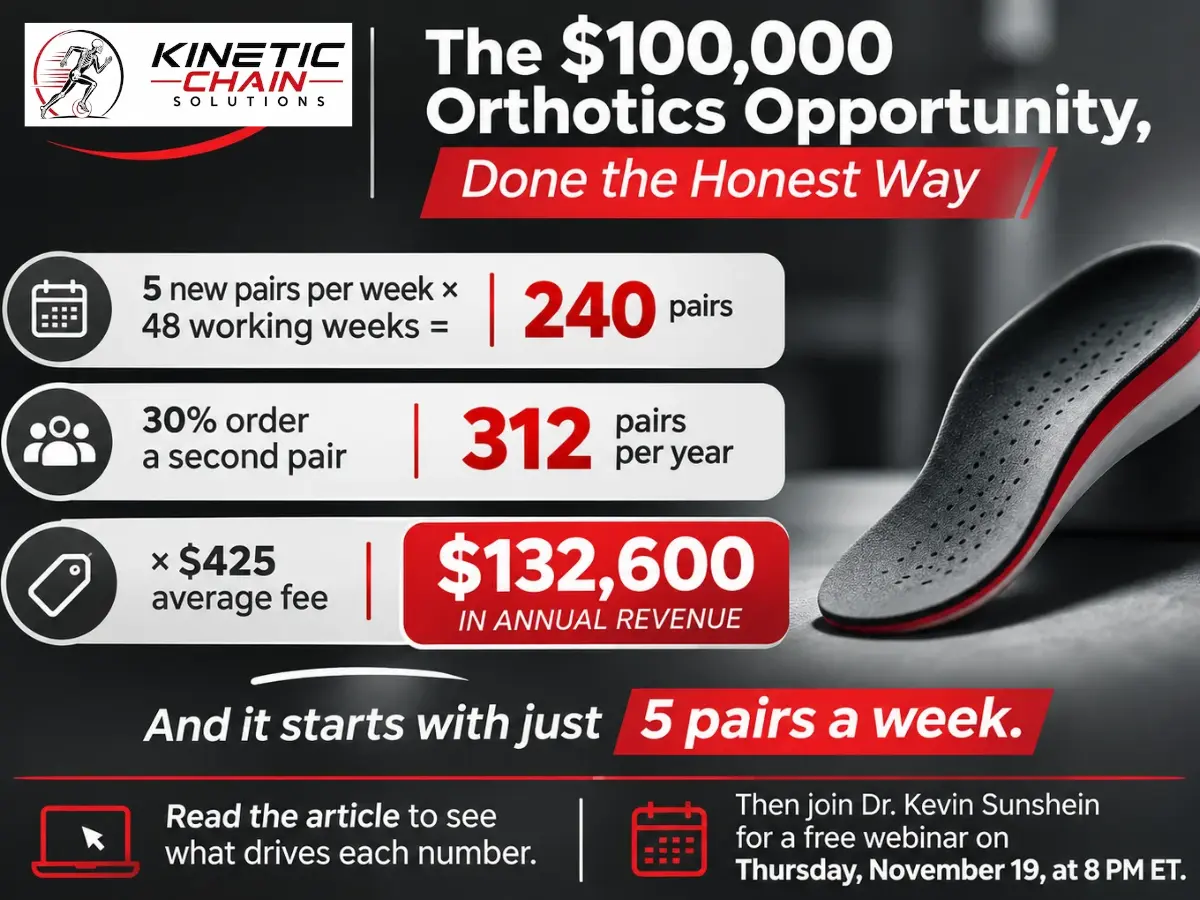
Here is the arithmetic behind the number, using the same example inputs as the revenue calculator on the Kinetic Chain Solutions homepage.
|
|
|
|
|
|
|
|
|
|
|
|
|
|
|
|
|
|
|
|
|
These are illustrations, not benchmarks or promises, and $132,600 is revenue, not profit. Device costs, staff time and overhead come out of it, so what reaches the bottom line depends on how efficiently your program runs. Your fee, volume and payer mix will move the result in either direction.
What the table shows is the structure. Five new pairs a week is one per clinic day. The $425 fee sits at the modest end of what practices already charge; published patient price guides commonly place podiatrist-provided custom orthotics between roughly $400 and $800 a pair. And nearly a quarter of the volume in this example comes from second pairs, patients the practice has already won.
So the real question is not whether $100,000 is possible. It is why so many practices that prescribe orthotics every week never get close.
Why orthotics are a natural cash-pay service
Custom foot orthotics occupy an unusual place in reimbursement. Original Medicare treats standalone custom foot inserts as statutorily excluded unless they are an integral part of a covered brace, and commercial coverage varies widely from plan to plan. Separate therapeutic footwear benefits exist for some patients with diabetes, but for the patient with plantar heel pain or a painful knee, orthotics are very often an out-of-pocket purchase, sometimes paid with HSA or FSA funds. The CMS policy explains the limited circumstances in which orthopedic footwear and associated inserts are covered, including footwear integral to a covered brace and separate rules for diabetic therapeutic footwear.
That cuts both ways. The patient makes the decision, not a claims processor, which gives the practice a service it can price on value. It also means patients judge that value directly. When someone pays for a device themselves, they notice whether it works, whether anyone explained it, and whether anyone checked on them afterward.
The four leaks that keep most orthotics programs small
When orthotics revenue stalls, the instinct is to look for more patients. Usually the patients are already in the chair. The revenue leaks out in four places.
1. The identification leak.
Patients who would benefit never hear a recommendation because the exam stays focused on the chief complaint. A patient booked for a callus may also have a limb length difference, early posterior tibial strain, or knee pain they never thought to mention. If the evaluation doesn't look up the kinetic chain, those patients leave without an option they would have wanted.
2. The conversion leak.
"You might want to think about orthotics" is not a recommendation. Patients hear it as an add-on and compare it to the $40 insert at the pharmacy. Most price objections are really clarity objections: the patient doesn't understand what the device will do for their specific problem, so the cost feels arbitrary.The APMA resource explains the difference between custom prescription orthotics and ordinary retail shoe inserts, including how custom devices are prescribed and made for an individual's feet. Practices looking to improve these conversations can also explore how to explain custom orthotics to patients who question the cost.
3. The outcome leak.
A device that hurts, doesn't fit the patient's shoes, or doesn't change their symptoms ends up in a closet. Each failed pair costs a remake, chair time, sometimes a refund, and the referral that patient would have sent you.
4. The continuity leak.
Patients who love their orthotics often need more than one pair: work boots, dress shoes, athletic shoes. Devices wear and need replacement. Family members have the same complaint. Without a follow-up visit and a reason to return, that demand quietly goes elsewhere.
Notice that only one of those leaks is about selling. The other three are clinical and operational.
Why selling harder doesn't fix it
Practices that try to grow orthotics with a script often find the script makes things worse. A recommendation delivered without real clinical confidence feels like pressure, and patients can tell. The providers who build durable programs do something different: they get better at the biomechanics first, and the conversation gets easier because they believe what they are saying.
That is the logic behind the KCS Method, which moves through five stages: Understand, Create, Communicate, Implement, Grow.
- Understand closes the identification leak: a consistent, three-plane look at how the foot and the rest of the kinetic chain are loading.
- Create closes the outcome leak: capture and prescription decisions tied to what the patient's tissues actually need.
- Communicate closes the conversion leak: explaining the device in the patient's own terms, connected to the problem they came in with.
- Implement turns all of it into something your team can repeat on a busy Tuesday, not just on a good day.
- Grow is what happens when the first four are working: referrals, second pairs, and a service patients ask for by name.
What a sustainable orthotics program looks like
You can usually tell a strong program by its routines rather than its revenue. For a more detailed starting point, read Building a Cash-Pay Orthotics Program: Where to Start. The patient with a qualifying complaint gets the same biomechanical evaluation regardless of which day they come in. The capture is done one way, by people trained to do it that way. Every prescription has a stated purpose. The explanation takes about two minutes and uses the patient's own words. Dispensing includes a shoe check, a break-in plan and a follow-up visit that is booked before the patient leaves.
And someone tracks four numbers:
- Patients who met the criteria for orthotics
- Patients who received a clear recommendation
- Pairs dispensed
- Patients still wearing their devices at follow-up
The gaps between those numbers show you exactly which leak to fix first.
Run your own numbers
Pull the last 90 days. How many patients presented with heel pain, tendon complaints, knee pain or other mechanically driven problems? How many left with a recommendation? How many pairs did you dispense, and how many came back unhappy? Multiply your real margin by the pairs you are missing, not the pairs you hope to add. For many practices, that one exercise turns the $100,000 figure from a headline into a plan.
If you'd like to walk through those numbers with someone who has built an orthotics program inside a working podiatry practice, schedule a 30-minute call with Dr. Kevin Sunshein. Not ready for a conversation yet? Join the free monthly webinar (Thursday, November 19, at 8 PM EST) or explore the KCS Method.
Frequently asked questions
How much revenue can custom orthotics add to a practice?
It depends on your patient volume, fee, costs and how consistently you identify, convert and retain orthotics patients. As an illustration, five new pairs a week at a $425 average fee, with 30% of patients ordering a second pair, comes to about $132,600 in annual revenue before costs. Your own numbers are the only figures that matter, which is why tracking them comes first.
Does Medicare cover custom foot orthotics?
Original Medicare generally does not cover standalone custom foot orthotics; they are statutorily excluded unless they are an integral part of a covered brace. Separate therapeutic shoe and insert benefits apply to qualifying patients with diabetes. Commercial and Medicare Advantage coverage varies, so verify each patient's plan.
Will a cash-pay orthotics service feel salesy to patients?
It feels salesy when the recommendation is vague. When patients understand how a device addresses their specific problem, and they can see the evaluation behind it, the conversation is clinical rather than commercial.
Is this only for podiatrists?
Kinetic Chain Solutions works with podiatrists and chiropractors. The biomechanical principles apply to both; what each provider can prescribe and dispense depends on state scope-of-practice rules.
Where should a practice start?
Track the four numbers above for one quarter. They will tell you whether your biggest opportunity is in identification, conversion, outcomes or follow-up.